Introduction :>
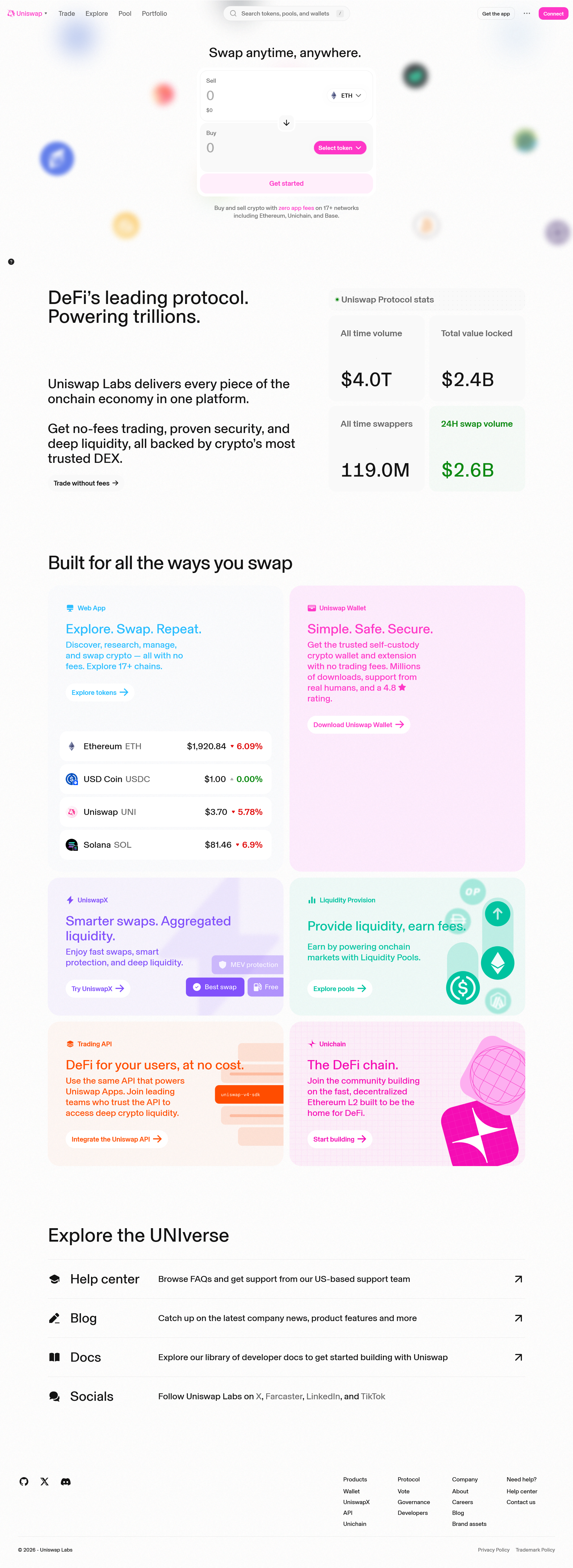
Uniswap is one of the most influential decentralized finance (DeFi) protocols in the cryptocurrency ecosystem. Launched in 2018 by Ethereum developer Hayden Adams, Uniswap transformed the way digital assets are traded by eliminating the need for traditional intermediaries such as centralized exchanges. Built on the Ethereum blockchain, Uniswap enables users to swap cryptocurrencies directly from their wallets through smart contracts, creating a permissionless and transparent trading environment.
What is Uniswap?
Uniswap is a decentralized exchange (DEX) that allows users to trade cryptocurrencies without relying on a central authority. Unlike conventional exchanges that use order books to match buyers and sellers, Uniswap employs an Automated Market Maker (AMM) system. This innovative approach uses liquidity pools instead of order books, enabling continuous trading and improved accessibility.
The platform is powered by smart contracts that automatically execute transactions based on predefined rules. Users maintain full control of their funds throughout the trading process, reducing the risks associated with centralized custody.
How Uniswap Works ://
At the core of Uniswap are liquidity pools, which contain pairs of tokens supplied by users known as liquidity providers. These providers deposit equal values of two different cryptocurrencies into a pool and, in return, receive liquidity provider (LP) tokens representing their share of the pool.
When traders swap one token for another, they interact with the liquidity pool rather than another trader. Prices are determined using a mathematical formula known as the constant product model:
The UNI Governance Token ://
In September 2020, Uniswap introduced the UNI governance token. UNI grants holders the ability to participate in protocol governance by voting on proposals related to platform upgrades, fee structures, treasury management, and ecosystem development.
The launch of UNI was notable because early users of the platform received token distributions through one of the largest and most celebrated airdrops in cryptocurrency history. Governance has since become a key component of Uniswap's decentralized structure.
Key Features of Uniswap ://
1. Decentralization :/
Uniswap operates without a central authority. Anyone with a compatible cryptocurrency wallet can access the platform without creating an account or undergoing extensive verification procedures.
2. Permissionless Access :/
Developers can create and list new tokens without requiring approval from a centralized entity. This openness encourages innovation within the Ethereum ecosystem.
3. Liquidity Provision :/
Users can earn a share of trading fees by supplying assets to liquidity pools. This mechanism incentivizes participation and helps maintain market efficiency.
4. Transparency :/
All transactions and smart contract activities are recorded on the blockchain, allowing anyone to verify and audit platform operations.
5. Composability :/
As an open-source protocol, Uniswap integrates seamlessly with numerous DeFi applications, including lending platforms, yield aggregators, and decentralized derivatives markets.
Advantages of Uniswap //
1. Eliminates reliance on centralized intermediaries.
2. Offers global accessibility and 24/7 trading.
3. Provides opportunities for passive income through liquidity provision.
4. Enhances user control over digital assets.
5. Supports a wide range of Ethereum-based tokens.
6. Promotes innovation through open participation.
Challenges and Risks //
Despite its advantages, Uniswap presents several challenges:
Impermanent Loss :/
Liquidity providers may experience losses when token prices fluctuate significantly compared to simply holding the assets.
Smart Contract Risk :/
Although audited and widely used, smart contracts can contain vulnerabilities that may be exploited by attackers.
Network Fees :/
Because Uniswap operates primarily on Ethereum, users may face high transaction fees during periods of network congestion.
Token Quality Concerns :/
The permissionless nature of the platform means fraudulent or low-quality tokens can be listed, requiring users to conduct thorough research before trading.
Impact on Decentralized Finance ://
Uniswap has played a foundational role in the growth of the DeFi sector. By introducing an efficient AMM model, it inspired numerous decentralized exchanges and financial applications. The protocol has facilitated billions of dollars in trading volume and demonstrated the viability of decentralized financial infrastructure at scale.
Its innovations have influenced the broader blockchain industry, encouraging experimentation with decentralized governance, liquidity mining, and automated trading mechanisms.
Future Outlook ://
As blockchain technology continues to evolve, Uniswap is expected to remain a significant player in decentralized finance. Ongoing developments in scalability, cross-chain interoperability, and governance could further enhance its capabilities and user experience. The protocol's commitment to decentralization and open access positions it as a cornerstone of the emerging Web3 ecosystem.
Conclusion ://
Uniswap has fundamentally changed how cryptocurrencies are exchanged by replacing traditional order-book systems with automated liquidity pools. Its decentralized architecture, governance model, and accessibility have made it one of the most important innovations in modern finance. While users must be aware of associated risks, Uniswap continues to demonstrate the transformative potential of blockchain technology and decentralized financial services.

HTML Generator